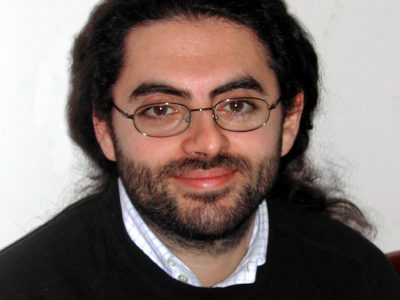
FRANCO DOMENICO CICIRELLI
Senior Researcher

Research Activity
The research activities of the QCC group focus on the design and execution of intelligent algorithms for solving problems of interest across a wide range of application domains, through the use of new architectures that enable the convergence of heterogeneous computational levels, including Cloud, Edge Computing, the Internet of Things, and quantum computers.
The convergence between classical and quantum computing is becoming essential in modern computer science for at least three reasons: 1) new architectures must be able to integrate classical and quantum hardware in order to execute algorithms with heterogeneous requirements; 2) in the current NISQ (Noisy Intermediate-Scale Quantum) era, the most promising algorithms are hybrid-variational ones, in which quantum computation is parametric and parameter tuning is performed through classical methods; 3) quantum algorithms can be applied to data coming from advanced classical devices, several of which (robots, drones, advanced sensors) are available to the QCC group.
In particular, the aim is to use quantum hardware to improve the efficiency and scalability of machine learning and optimization algorithms. The research activities focus on Quantum Machine Learning (QML), a paradigm that exploits the intrinsic parallelism of quantum systems and the exponential dimensionality of Hilbert space to process and analyze data, offering potential advantages in clustering, classification, regression, and prediction tasks. Two relevant examples currently under investigation are Quantum Reservoir Computing and Quantum Extreme Learning Machines, architectures inspired by their classical counterparts but enhanced through the guided evolution of quantum systems.
The group’s research activities range from methodological and architectural approaches for designing cognitive and intelligent Cyber-Physical systems to the study of distributed algorithms and protocols capable of exploiting the full potential of the continuum to achieve adaptive behaviors, learn control policies, predict user needs, adopt predictive maintenance techniques, ensure specific security requirements, recognize anomalous situations, and respond to them. Current research topics include:
Goals
The Quantum and Continuum Computing (QCC) group at ICAR conducts research in the field of Continuum Computing, a concept that encompasses heterogeneous platforms and devices within a multi-layered architecture spanning from Cloud to Edge Computing, the Internet of Things (IoT), and quantum computers. The goal is to design and execute intelligent algorithms for data analysis, computation, and problem-solving, making optimal use of the computing capabilities available at each level of the continuum. This approach supports a wide range of application domains, such as smart cities, cognitive buildings, and energy management. Depending on the complexity of the problems and the application workload, the execution of algorithms can either be migrated from the Cloud toward the peripheral ecosystem, leveraging new AI chips capable of supporting complex real-time applications on IoT devices, or performed on quantum computers, to exploit and anticipate the scalability achievable through the greater richness of the quantum space (Hilbert space) and the ability to perform parallel computations on superposed states.
Application Fields
The main fields of application are: energy management, smart cities, smart streets, smart grids, intelligent buildings, smart water, urban intelligence, cognitive smart homes, smart mobility, smart parking, and fluid dynamics.





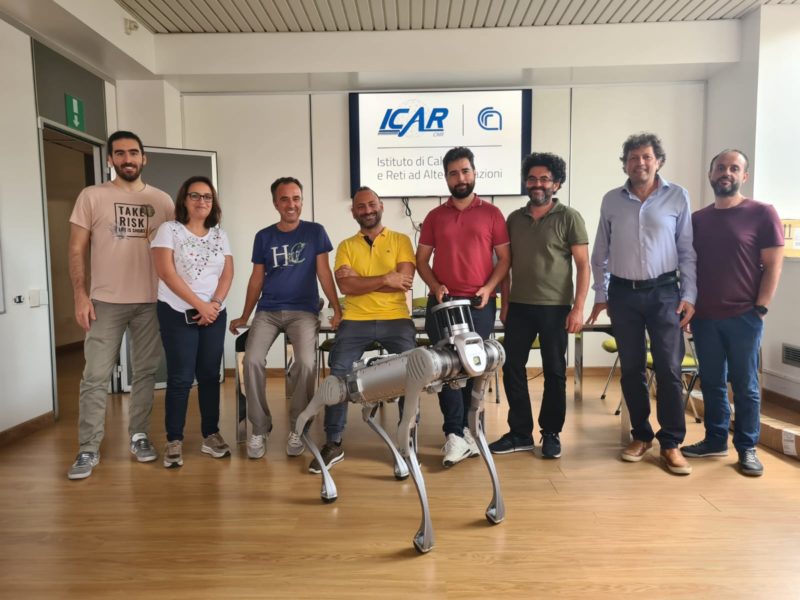
The QCC group at the Rende site, within the University of Calabria, has recently strengthened its commitment to technological innovation by equipping itself with cutting-edge instruments to enhance advanced research and applications in the industrial and medical fields. The synergy between ICAR and the University of Calabria contributes to a stimulating research environment, fostering the exchange of ideas and collaboration among researchers.
Among the most innovative technologies introduced, the Unitree B2 quadruped robot stands out, a state-of-the-art mobile robotic system capable of operating autonomously in complex environments. This technology is applied in numerous fields, from advanced robotics to automation, and represents a valuable resource for experimental research.
The group has also adopted the portable EEG headset, a device designed for real-world applications that allows real-time monitoring of brain activity. This technology opens up new frontiers in human-machine interfaces, enabling advanced interactions in dynamic and complex environments.
Another innovation includes the latest generation smartglasses, such as the Magic Leap 2 Developer Pro and the Epson Moverio BT-45CS. These smart glasses offer augmented reality features and integrate voice commands, head, eye, and hand gesture tracking, making them extremely versatile tools for industrial and medical applications. In particular, they are ideal for real-time data visualization, assistance in technical and surgical operations, and guidance in complex environments.
Thanks to these advanced technologies, the team aims to attract new generations of researchers, creating a stimulating environment open to innovation. The close collaboration with the University of Calabria allows full exploitation of the potential of multidisciplinary research, fostering the growth of scientific and technological knowledge.