ICAR’s infrastructure provides services for artificial intelligence, high-performance computing, research environments and FAIR data management.
ICAR’s infrastructure services are organised into integrated layers, ranging from computing and storage resource management to the application environments made available to users.

AI e Machine Learning
- Access to GPU resources for artificial intelligence and machine learning activities.
- Virtual Research Environments (VREs) for developing and running research activities.
HPC
- Access to HPC clusters for high-performance computing workloads.
- Job scheduling and orchestration through SLURM..


User Environments and VREs
- On-demand JupyterHub for notebooks and customised interactive environments.
- Web-based VREs and REST APIs for accessing services and integrating applications and workflows.
Cloud and Storage
- OpenStack Infrastructure as a Service (IaaS) for managing computing resources and cloud services.
- Data storage on BeeGFS and NVMe file systems, supporting the publication and sharing of FAIR data through Digital Object Identifiers (DOIs).

Service architecture
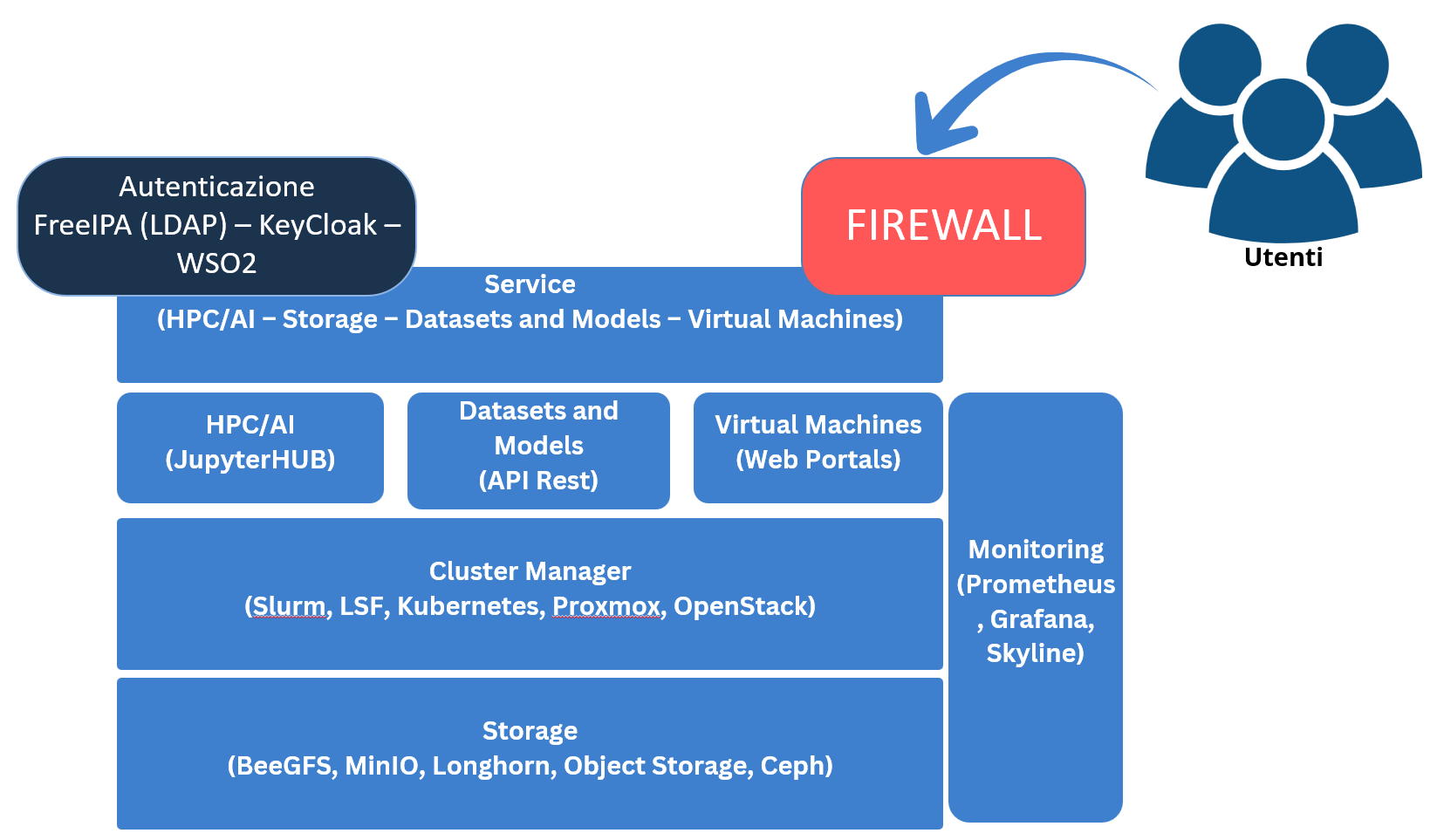
The service architecture is organised according to an integrated, multi-layer model that enables the coordinated use of the distributed resources of the ICAR infrastructure.
A common authentication and authorisation system manages user access to services in accordance with the policies defined for each resource. Web portals and APIs provide access to high-performance computing and artificial intelligence environments, dataset and model management services, virtual machines and customised research environments.
Application services rely on systems for orchestrating computing resources and on distributed storage solutions. Centralised monitoring tools also make it possible to monitor the infrastructure’s availability, performance and utilisation.
This organisation provides the technological foundation for the progressive development of a single access point to Apollo services, while preserving the operational characteristics and access policies of the infrastructures and projects that contribute to it.